
You’ve seen the images from Hawaii, California, the Mentawais: close up surf shots looking right down the barrel with the surfer seeming to pop out of the picture. It seems easy, but this type of image may be one of the most complex sport shots to capture. Let’s unfreeze the photograph for a moment and put this all into perspective.
Swimming: The first thing to understand is that an in-the-water photographer is not standing on shore with his/her camera securely mounted to a sturdy tripod. Instead, they are in the elements swimming, kicking, ducking, grabbing the bottom, etc. while holding a five pound weight of a camera inside a water housing. First, one needs to get out to the lineup from shore. This means either arriving on a boat/jetski or swimming out from shore, diving under all the incoming surf. Keep in mind that one arm is occupied holding the camera gear, leaving just one arm to paddle in addition to your legs kicking. For anyone that has tried to swim with one arm, its not very efficient. In other words, you are relying about 90% on the strength of your swim kick. A good pair of fins is critical for anyone venturing out into the surf to shoot.
Incoming Surf: Unlike swimming in a pool, however, incoming surf, especially heavy surf, often requires you to hold onto the reef or dig your hands into the sandy bottom to keep from being dragged in by each wave. Again, this is often a challenge when holding on to your camera with one hand. Waves often come in sets. You may dive under the first wave and pop up on the other side only to face the second wave crashing on your head. Not good. If one wave pushes you back toward shore (or shallow reef), the second or third wave may be a real problem. This is why it is critical to get out of the impact zone as quickly as possible.
Side Currents and Rips: So here’s the dirty little truth about shooting surfing from the water: you are never in the right place for long! Not only is the surf naturally pushing you toward shore, but there is typically some sort of side current. This may be pushing you away from the action or too close into the action. You also need to be aware of where all the water that pushed to shore is going. What goes in must come out. Quite often, a river of outgoing water streams out to sea in what is called a Rip: not “rest in peace,” but sometimes pretty close to it! On sand bottom breaks, one really needs to keep on eye on the rip because they tend to shift as the sand builds in different areas. This is all guaranteed to make your calves burn as you constantly kick to keep yourself in position.
Setting Up In the Water (barrel shot): Congratulations, you have made it out from shore in one piece, avoided the rip and are now floating in the lineup with all the surfers. Guess what? You went too far! Other than a smiling face or two, there is not a whole lot to photograph out where the surfers are waiting for the next wave. No, the action takes place where the waves are actually breaking. So back in you swim to where you think will be a good spot. What is the best spot? That depends on the wave and the surfer you are working with. If you surfer is good with getting barreled, you need to set up down the line from the takeoff to give your surfer time to drop in, turn and get low. The best shot, from the perspective of the finished image, has you in the barrel too with the lip coming over your head, maybe even a half in, half out shot. Of course, every wave has a different amount of energy and may break further out or further in the last wave, so there is always a bit of guess work and luck.
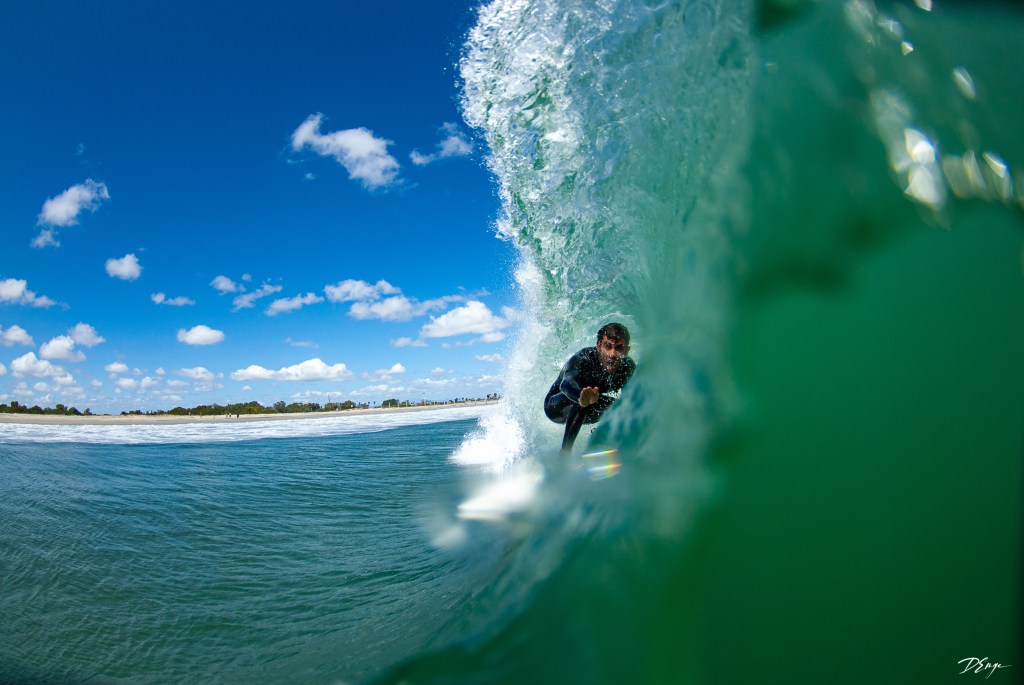
Setting Up In the Water (hack or air shot): If the waves are better suited for a massive hack or your surfer likes to launch, then your set up is going to be quite different. You need to be in a spot a little further away from the takeoff than where you would be for a barrel shot. The surfer needs to paddle in, make the drop, complete a bottom turn and find the spot on the wave where he/she is going to make the hack or punt, gather enough speed, and then execute without going past you. Here you have a few choices: Images from just in front of the wave look great, as do images from the lip or even behind the wave if its an aerial or the surfer gets the fins free. Again, this often takes a lot of work to understand the tendencies of the surfer you are working with.

Lighting: As if the moving water, cresting waves, and performance of your surfer don’t create enough variables, there is always the issue with lighting. Sometimes, a backlit wave looks really cool. More often, however, this means your surfer will be in the shadows and loose too much detail. Also, the more the sun hits the dome of your water housing, the more likely any water spots on the dome will distort the image. Water spots have ruined more shots than I care to think about! So if your surfer prefers to go into the sun and if the wave sets up that way, the money shot is most likely with the sun directly overhead or at your back.
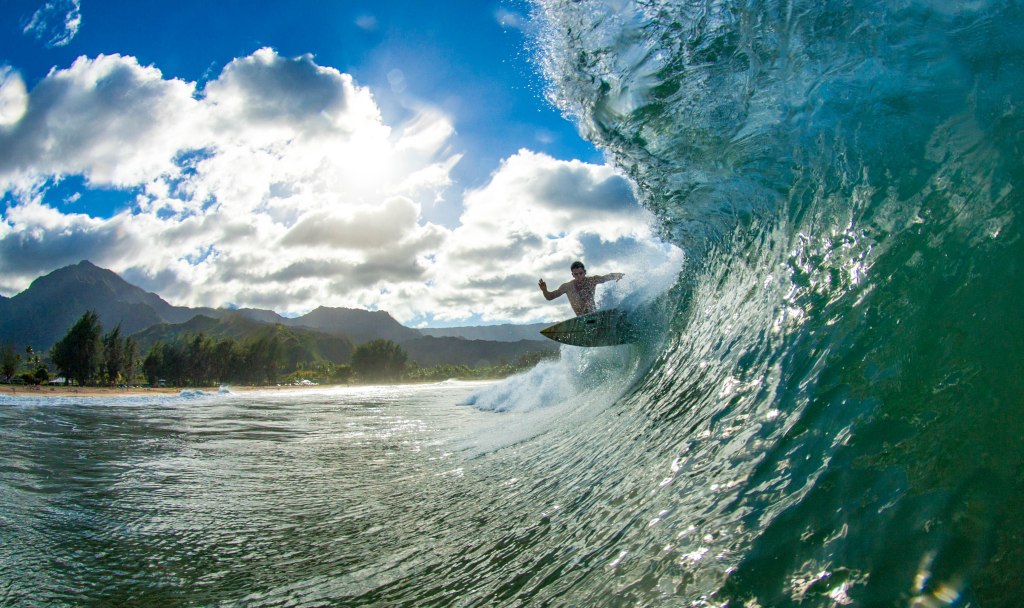
After the Shot: You got everything set up just right and your surfer cooperated to a “T.” You hung in long enough to see the barrel closing over your surfer’s head and squeezed off 10 or so images. You ducked out of the way just in time to not get nailed by the tip of the board. You were fully committed and now you pay the price! For sure enough, that extra moment staying focused on the shot prevented you from ducking completely through the back of the wave. You feel the power pull you up and then over the falls where you slam into the bottom and ragdoll for a while. Letting your body relax is good advice here, but the best advice is to not get hit in the face or head with your metal water housing. After finding the way up and gasping for breath, you must remember to give your surfer a thumbs up, pretend it was all planned, and then repeat the process all over again!
Satisfaction: So as you can see, shooting in the water is quite a challenge. The reward, however, is so worth the challenge. There is great satisfaction with accomplishing something that requires skill, stamina, timing and luck. What’s even better is that you have a ready audience of one who can’t wait o see themselves caught in a moment of surfing glory. When you exit the water with your surfer, it is generally all smiles and stoke!
 Water Clicker Photo Blog